Choosing between a large 4WD and a smaller SUV is not only about appearance. You may need extra clearance and space for journeys between Lilongwe, Blantyre, Zomba or the lakeshore. In short, the Toyota Prado in Malawi is a good fit when you regularly need that clearance, space and 4WD ability, but it is a costly choice for mainly urban driving. A large SUV can cost more to fuel, maintain and import.
Toyota Japan’s Land Cruiser Prado model-history and fuel-economy pages list 150 Series vehicles built through April 2024, with approximately 8.3–11.2km/L under WLTC across the listed variants (Toyota Japan, Land Cruiser Prado fuel-economy catalogue). That is catalogue testing, not a promise of Malawi driving economy. This guide looks at the Prado’s genuine strengths, its drawbacks and who should consider another Toyota instead.
Quick Answer
- The Prado suits buyers who genuinely need high clearance, family space and 4WD ability.
- It is usually poor value for short urban trips and buyers focused on the lowest running costs.
- Japanese-market examples include 2.7-litre petrol and 2.8-litre diesel formats.
- Larger engines increase the importance of checking Malawi’s duty calculation.
- Vehicle price, duty, VAT, customs clearance and inland transport must be budgeted separately.
Toyota Prado suitability for Malawi
Toyota Japan’s Prado model-history pages list five- and seven-seat versions across 150 Series grades built through April 2024, with full-time 4WD on representative models (Toyota Japan, Land Cruiser Prado model catalogue). That combination makes the Prado suitable when you carry passengers, luggage and regularly leave smooth city roads.
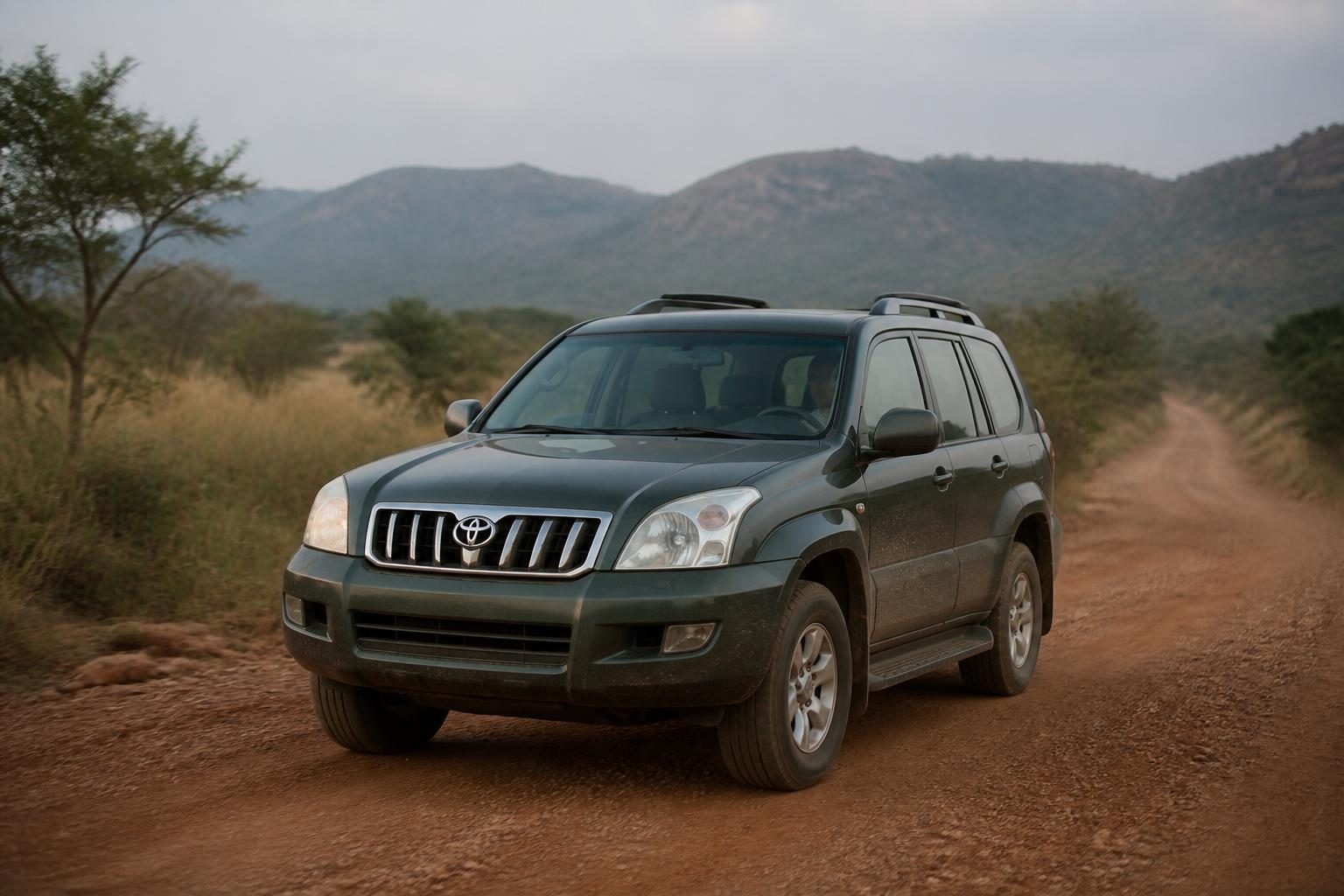 A Toyota Land Cruiser Prado travels along a rural red dirt road beneath distant hills.
High clearance helps on uneven rural surfaces, gravel roads, deep ruts and rough approaches. Four-wheel drive can also add confidence on loose surfaces, steep gradients and routes where a two-wheel-drive car may struggle. It does not make every road easy, though. Tyres, driving technique and ground conditions still matter.
A Prado can make sense for a family travelling between Lilongwe and Blantyre, carrying luggage to the lakeshore or reaching rural accommodation. Seven seats are useful when you need them, but check the exact vehicle because seating and equipment vary by year and grade. When the third row is in use, luggage space also becomes more limited.
The Prado’s strongest Malawi advantage is not simply luxury or road presence. It is the combination of right-hand-drive availability, clearance, passenger space and long-distance ability. If your roads and trips do not require those strengths, the same size becomes a disadvantage around town.
Compare Toyota vehicles available for Malawi import when you are ready to judge the Prado against smaller Toyota SUVs.
Which Toyota Prado engine should Malawian buyers consider?
Toyota Japan’s Prado model-history pages list common 150 Series examples with 2,693cc petrol or 2,754cc diesel engines. In the MRA’s 2024 FAQ, the available tariff material places both within the 2,501–3,000cc band, so the 61cc difference alone does not automatically create a separate duty band. Age, CIF value, vehicle classification and current tariff rules also affect the calculation (MRA, Frequently Asked Questions, 2024).
The 2.7-litre petrol format can be a straightforward choice in some Japanese-market grades. It may suit buyers who prefer petrol, but a large SUV carrying passengers and luggage can still use considerable fuel. Toyota’s published WLTC figures place some petrol examples near the lower end of the Prado range.
The 2.8-litre diesel may suit loaded travel, gradients and longer routes, depending on the exact grade and condition. That can be useful around hilly areas and on extended family journeys. Diesel systems can also be more complex, depending on the model year, so the inspection report and service history deserve close attention.
Larger petrol engines appear in some Prado generations and grades. They offer smooth power, but their fuel use and engine-capacity exposure make them harder to justify for buyers watching the total import bill.
| Prado format |
Main strength |
Main drawback |
Likely buyer fit |
| 2.7-litre petrol |
Straightforward petrol option in some grades |
Can use more fuel under load |
Buyer prioritising choice and petrol use |
| 2.8-litre diesel |
Strong torque for passengers and gradients |
Higher complexity in some model years |
Frequent intercity or rural travel |
| Larger petrol |
Smooth power and strong performance |
Higher fuel and duty exposure |
Buyer with a clear need and larger budget |
Toyota Japan’s fuel-economy pages for 150 Series vehicles built through April 2024 record approximately 8.3km/L WLTC for some 2.7-litre petrol examples and up to 11.2km/L WLTC for some 2.8-litre diesel examples (Toyota Japan, Land Cruiser Prado fuel-economy catalogue). These figures compare test results, not guaranteed consumption in Malawi.
The Japanese 150 Series examples discussed here are above 2,000cc. Do not apply a smaller-engine estimate to one automatically. Read Malawi’s current vehicle import rules, then confirm the vehicle-specific calculation before payment.
Toyota Prado import costs in Malawi
Both the Prado’s 2,693cc and 2,754cc engines generally fall within the 2,501–3,000cc tariff band in the available material. Age, CIF value, vehicle classification and current tariff rules can still change the calculation, so engine size is a cost question, not just a specification. The vehicle price alone cannot show your final Malawi budget (MRA, Frequently Asked Questions, 2024; MRA, 2026/27 customs and excise tax measures, 2026).
A reliable Toyota Prado price in Malawi depends on model year, auction grade, mileage, engine, condition, shipping and currency movement. Without a confirmed, comparable Prado shortlist, publishing a fixed MWK range would give false precision. Treat any advertised figure as a vehicle price until the full invoice explains what it includes.
Your budget should separate these layers:
- Vehicle price
- Shipping
- Import duty
- Excise and VAT
- Port and customs-clearance charges
- Inland transport into Malawi
- Registration-related expenses
The customs value may use CIF, meaning cost, insurance and freight. Because the linked MRA business page does not clearly document a vehicle calculator, do not rely on it to estimate CIF, port charges, year of manufacture or engine-capacity costs. Ask for a vehicle-specific estimate and check the figures against the applicable MRA tariff material. That is why a confirmed calculation matters more than a generic online estimate.
A Prado can look affordable at the vehicle-price stage and still become difficult to justify after duty, clearance and inland transport. Compare the complete landed-cost estimate, not just the figure shown beside the vehicle.
Is the Toyota Prado expensive to run and maintain?
Toyota Japan’s fuel-economy pages for 150 Series vehicles built through April 2024 give 8.3–11.2km/L under WLTC, while separate older JC08 entries reach up to 11.8km/L (Toyota Japan, Land Cruiser Prado fuel-economy catalogue). These are different test cycles, so the Prado should not be described as economical without naming the engine and cycle.
In practical ownership, a large SUV can bring higher tyre, fuel and suspension costs than a compact Toyota. Heavier components can cost more to replace, while a full set of large tyres may be a significant expense. Fuel use also rises with passengers, luggage, traffic, hills and rough surfaces, so treat this as a general ownership expectation rather than a Prado-specific cost statistic.
Toyota Australia lists 2,755cc, 150kW, 500Nm and 7.6L/100km for its current Prado specification (Toyota Australia, Prado specifications, 2026). That is a newer Australian-market model and laboratory figure. Do not apply it to an older Japanese-market import.
Before payment, examine the auction sheet and inspection report for:
- Odometer consistency
- Accident or repair history
- Underbody damage or corrosion
- Suspension and steering wear
- Cooling-system condition
- Drivetrain comments
- Tyre size and remaining condition
- Diesel emissions equipment, where applicable
- Interior wear, smoke smell and dashboard damage
A cheaper older Prado only represents good value when its condition supports the saving. A neglected large SUV can quickly absorb the apparent purchase discount.
In summary: The Toyota Prado in Malawi makes sense for buyers who regularly carry people and luggage beyond smooth city roads, and who can absorb higher fuel, maintenance and import costs. For mostly urban driving, a smaller Toyota SUV is usually the more sensible fit.
Could a Toyota RAV4 be a more sensible alternative?
The 2024 Toyota RAV4 Hybrid page records 85,000km, a 4.5 auction grade, five seats, hybrid power and 4WD. That makes it a useful comparison for urban buyers, although it cannot replace the Prado’s seven-seat layout and large-SUV capability.
 2024 TOYOTA rav4
The vehicle is from the AXAH5X model family and is recorded as an automatic SUV in white; the exact 2024 hybrid code is AXAH54. Its five-seat layout may suit a smaller household, while the compact shape should be easier to manage in city traffic and tighter parking areas. The page does not provide a verified horsepower, torque or fuel-economy figure, so those numbers should not be assumed.
The RAV4 is not a direct 4WD replacement for a Prado. Its hybrid E-Four system and five-seat layout differ from the Prado’s full-time mechanical 4WD arrangement and available seven-seat format. It may still be the better fit if you mostly commute around Lilongwe or Blantyre, carry fewer passengers and want to limit tyre, fuel and maintenance exposure.
| If you need… |
More suitable direction |
| Seven seats, high clearance and frequent rough-route travel |
Toyota Prado |
| Five seats and mostly urban use |
Toyota RAV4 |
| Lower fuel and tyre exposure |
Usually the smaller SUV |
| Strong loaded-travel ability |
Prado, subject to engine and grade |
| A compact family SUV |
RAV4 |
| Lower import-cost exposure |
Compare the specific landed estimates |
How do you order a Toyota Prado from Japan through Carbarn Malawi?
The Malawi import rules and regulations page states that vehicles travel by RoRo to Dar es Salaam. Carbarn’s published estimates vary, so treat the shipping or route timeframe as an estimate and confirm it for the exact vehicle before paying. Also verify the auction sheet, inspection report, invoice and landed-cost estimate.
Review the Japanese auction sheet for the vehicle’s recorded grade, mileage and condition comments. Compare those details with the in-house inspection report, photographs, engine capacity, fuel type, drivetrain and odometer. The Japan-to-Malawi buying process explains how invoices, reports and shipping documents are handled.
Carbarn’s current import guidance is for right-hand-drive vehicles, with exceptions it identifies for special-purpose vehicles such as ambulances and fire engines. The country has no general import age limit, but vehicles more than five years old may require a certificate-of-fitness inspection before lawful road use or registration (Malawi Trade Portal, roadworthiness requirements). An older car still needs careful checks for rust, repairs, parts availability, resale prospects and likely maintenance.
Through Carbarn Malawi’s vehicle sourcing and inspection process, buyers review the official Japanese auction sheet and a Carbarn inspection report before ordering and payment. The listed vehicle and shipping price excludes duty, VAT and customs clearance, which are paid separately. The buying process describes dashboard access to invoices, inspection reports, the bill of lading and vessel tracking. Vehicles travel RoRo to Dar es Salaam, then by road into Malawi; confirm payment terms and any warranty conditions in the applicable proforma invoice.