Toyota Yaris Hybrid in Malawi: Fuel Economy, Features, Price & Ownership Guide
Toyota Yaris Hybrid in Malawi: Fuel Economy, Features, Price & Ownership Guide
Read Our Blogs today and Learn More
Loading ...
Frequently Asked Questions (FAQs)
Selected 2WD versions are rated at up to 36.0km/L under the WLTC test cycle, while E-Four versions are rated at 30.2km/L (Toyota Japan Yaris technical specifications, 2021). Actual consumption will vary with traffic, air-conditioning, tyre pressure, road conditions and driving style.
The Yaris is 3,940mm long and has five seats, according to Toyota Japan’s 2021 technical specifications. Those dimensions suit urban driving and maintained main roads. If you regularly use rough roads, inspect clearance, tyres, suspension and underbody condition carefully before choosing this compact hatchback.
Toyota’s technical data gives the Yaris Hybrid an official displacement of 1,490cc, although some listings round this to 1,500cc. That falls within the “not exceeding 1,500cc” range used in some tariff classifications, but final treatment also depends on HS classification, fuel type, age and current Malawi rates. The MRA FAQ, 2024, confirms that engine size affects duty, but it does not provide a Yaris-specific final bill. Check the current Malawi vehicle import rules and proforma invoice.
Routine servicing depends on the vehicle’s condition, mileage and parts needs, rather than the 1,490cc engine alone. The Yaris has a 36-litre fuel tank and hybrid system, so confirm access to a technician with suitable hybrid diagnostic equipment. Budget for servicing, tyres, fluids, brake checks and diagnostic work; actual repair costs depend on the car’s condition.
I am a Turkish-Australian automotive writer with a passion for hybrid vehicles and rugged 4WD adventures. My writing combines detailed technical insights with a love for outdoor exploration and Aussie driving culture. Having guest posted for leading automotive sites, my mission is to educate and inspire drivers considering greener and tougher vehicle options.
Fuel costs can make a small hybrid very appealing. However, a compact hatchback still needs to handle traffic, family errands and longer trips between towns.
The Toyota Yaris Hybrid is economical on paper, easy to drive and small enough for busy streets. It also has limits. Rear space, cargo capacity and lower clearance may matter more than fuel economy for some buyers.
Toyota Japan’s 2021 Yaris technical specifications rate selected 2WD hybrid grades at up to 36.0km/L under WLTC. This guide explains what that figure means in Malawi, alongside features, price bands, duty considerations and ownership checks.
The 1,490cc hybrid suits urban commuters and small households.
Vehicle price, duty, VAT and clearance are separate parts of the final cost.
Is the Toyota Yaris Hybrid a good car for Malawi?
Yes, if town driving is your main job. Toyota Japan’s 2021 technical specifications list a 3,940mm-long, five-seat hatchback, while the Toyota Yaris specifications database lists 2WD and E-Four hybrid variants. That size makes parking easier, but limits cargo space and rough-road confidence.
The Yaris could make a lot of sense around Lilongwe and Blantyre if most of your driving is in town. Its compact body should be easier to place on busy streets, while regenerative braking is one feature to understand when comparing hybrid ownership.
The five-seat layout works well for a single driver, couple or small family. It becomes less convincing when you regularly carry bulky goods, several adults or large luggage. The Yaris hatchback is also different from the taller Yaris Cross, so check the body style carefully before comparing prices.
Official results are strong, but they are not a promise from your fuel gauge. Toyota Japan’s 2021 Yaris technical specifications rate the Hybrid X 2WD at 36.0km/L WLTC and E-Four variants at 30.2km/L. The test helps compare drivetrains, while traffic, air-conditioning and road conditions decide actual consumption.
WLTC is a laboratory test cycle covering urban, suburban and highway driving. Toyota’s 2019 global Yaris launch announcement explains that the 36.0km/L result combines these different driving modes (Toyota Global, “Toyota to Launch New Model Yaris in Japan”, 2019).
Variant
Drive
Official WLTC economy
Hybrid X
2WD
36.0km/L
Hybrid G
2WD
35.8km/L
Hybrid Z
2WD
35.4km/L
Hybrid X, G or Z
E-Four
30.2km/L
Source: Toyota Japan Yaris technical specifications, 2021. These are official WLTC test results, not guaranteed real-world consumption.
The useful Malawi comparison is not simply “hybrid versus petrol”. It is also 2WD versus E-Four. The 2WD versions have the stronger official economy figure and are probably the better fit for mostly paved urban routes.
The Yaris has a 36-litre fuel tank, according to Toyota’s technical data and the relevant specification record. That helps reduce fuel-stop frequency, but it does not provide a guaranteed driving range. Passenger loads, tyre pressure, driving style and heavy air-conditioning use will all affect results.
2023 Toyota Yaris Hybrid: A Practical Example
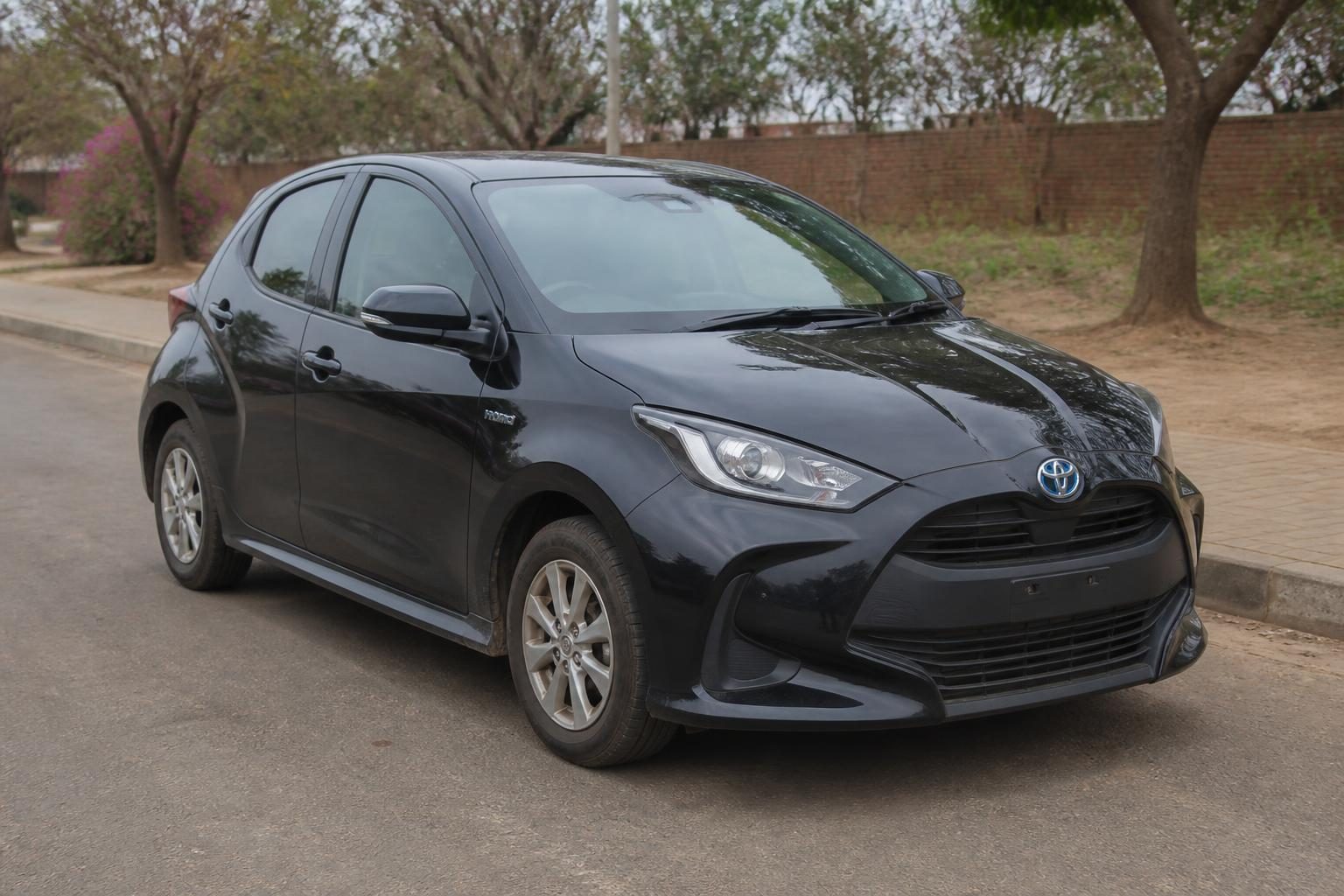
The 2023 Toyota Yaris Hybrid is a useful real-vehicle example: the listing identifies a 1,490cc, front-wheel-drive hatchback with automatic transmission, five seats, 53,000km and auction grade 4. Those details come from the vehicle page titled “2023 Toyota Yaris in Malawi” (2026), and should be checked again before ordering.
2023 Toyota Yaris
This specification suits buyers who mainly drive on paved roads and want an automatic city car. The 2WD drivetrain avoids paying for extra traction that you may rarely use, while Toyota’s official data gives the engine displacement as 1,490cc. Some Carbarn listings display 1,500cc as a rounded commercial description, so confirm the exact HS classification and current tax treatment for the vehicle.
An auction grade is a useful starting point, not a complete inspection. The 53,000km odometer reading also needs context. Service evidence, auction notes, underbody condition and repair history matter just as much as the number on the dashboard.
What should you check on this vehicle example?
Confirm the live mileage, grade, drivetrain and engine size.
Read the official Japanese auction sheet.
Read the in-house inspection report.
Check accident history, corrosion, underbody damage and repair notes.
Review the estimated landed cost and final proforma invoice.
Which features and drivetrain should you choose?
The common Japanese Yaris Hybrid uses a 1,490cc M15A-FXE inline three-cylinder engine, with 67kW/91PS quoted as engine maximum output, and a CVT. Toyota’s 2019 global launch announcement identifies the 1.5-litre three-cylinder hybrid system and E-Four electric four-wheel drive, while the 2022 HYBRID G MXPH15 specification record confirms the model code and equipment.
Relevant specifications include five seats, foldable rear seats, air-conditioning, power windows and steering adjustment. Listed safety equipment includes airbags, ABS, traction control, brake assist and electronic brake-force distribution. Equipment can change by year, grade and option package.
Variant
Best fit
Main strength
Trade-off
Hybrid X 2WD
Economy-focused city buyers
Highest official WLTC figure
Equipment may be simpler
Hybrid G 2WD
Most buyers
Balanced equipment and economy
Options must be checked
Hybrid Z 2WD
Buyers wanting more features
Higher specification
Higher purchase price
E-Four
Buyers needing extra traction
Electric four-wheel drive
Lower official economy
E-Four can help when extra traction matters, but buyers should still assess the route, tyres, suspension and underbody rather than treating it as a rough-road vehicle. Its official WLTC figure is 30.2km/L, compared with up to 36.0km/L for the Hybrid X 2WD.
Toyota Yaris Hybrid ownership in Malawi
Ownership may be manageable when the vehicle has clear reports and you can access a technician familiar with Toyota hybrid systems. Toyota’s 2021 technical data lists a 36-litre tank and five seats, while the 2023 vehicle page records a grade 4 car with 53,000km. That combination may suit daily use, not every road or family.
Toyota’s broad model range may make some general servicing familiar, but local support for this specific hybrid should be confirmed before purchase. Ask whether the technician has suitable hybrid diagnostic equipment. Plan for routine servicing, tyres, fluids, brake checks and any required hybrid-system diagnosis.
Regenerative braking can reduce brake use in some driving conditions, but it does not remove brake maintenance. As a compact hatchback, the Yaris is likely to feel tighter in the rear and boot than a larger wagon or people-mover, so compare your usual passenger and luggage needs.
The most useful ownership check is matching the car to your route before focusing on its fuel figure. If you regularly use rough roads, inspect the underbody, tyres and suspension carefully. A fuel-efficient car that struggles on your normal route is poor value.
Five checks before choosing one
Confirm whether the car is 2WD or E-Four.
Match the engine size to the current import classification.
Read both vehicle reports.
Consider mileage alongside condition and service evidence.
Compare the full landed-cost estimate with your available budget.
What price should you expect for a Toyota Yaris Hybrid in Malawi?
Expect a broad guide rather than one fixed Toyota Yaris Hybrid price in Malawi. The Toyota Yaris listings page checked on 21 August 2026 showed changing vehicle and shipping prices (Toyota Yaris listings in Malawi, 2026). Because displayed currency and exchange-rate assumptions can change, use the specific vehicle page and its current landed-cost estimate rather than relying on an old band.
In the observed listings, older or higher-mileage cars often appeared nearer the lower end, while newer examples with lower mileage, stronger auction grades or higher equipment could move towards the upper end. This is a market pattern, not a pricing rule. Prices change with auction results, currency movements and shipping arrangements.
Treat this as a vehicle or CIF guide. CIF means cost, insurance and freight. It is not the same as the final landed or on-road cost. Import duty, excise duty, VAT, customs clearance and inland delivery need to be added separately.
Engine size matters, but it does not determine the final tax bill alone. Toyota’s official displacement is 1,490cc, which falls within the “not exceeding 1,500cc” engine-capacity range used in some tariff classifications; Carbarn may display the rounded figure 1,500cc. Final treatment also depends on the vehicle’s HS classification, fuel type, age and current Malawi rates. The Malawi Revenue Authority FAQ, 2024, confirms that engine size affects motor-vehicle duty. The Malawi Trade Portal importation guidelines, 2026, explains that customs value uses CIF and HS classification. Its vehicle guidance also covers Customs declarations, importer registration and supporting documents, so confirm the current requirements before shipping.
Check the current Malawi vehicle import rules, then confirm the exact duty, VAT and clearance charges on the proforma invoice.
Who should buy a Toyota Yaris Hybrid, and who should skip it?
Choose the Yaris Hybrid when economy and easy city driving matter more than space. Toyota Japan’s 2021 technical specifications give it five seats, a 2,550mm wheelbase and up to 36.0km/L WLTC in 2WD form. Those figures describe a compact commuter, not a vehicle chosen primarily for heavy loads or demanding roads.
It is a good fit for:
Daily commuters in Lilongwe or Blantyre.
Singles, couples and small families.
Buyers wanting a compact automatic hatchback.
Drivers who mostly use paved roads.
Buyers considering a 1,490cc hybrid.
Consider another vehicle if you:
Carry bulky goods regularly.
Need generous rear-seat or boot space.
Travel rough roads often.
Prefer a higher driving position.
Need a vehicle for large-family or commercial use.
A Toyota Aqua hybrid may suit buyers comparing compact Toyota hybrids. A Corolla Fielder may offer more luggage-focused practicality, while the Yaris Cross has a taller crossover body.
How does the Toyota Yaris Hybrid import process work?
Carbarn’s import-rules page gives an estimate of about 24 to 34 days from Japan to Dar es Salaam, followed by inland transport into Malawi. Treat that as a port-arrival estimate, not a guaranteed door-to-door time. The page identifies RoRo shipping and RHD eligibility, but customs clearance and separate taxes still apply; its “no age limit” statement does not remove age-related tariff classification.
The route is Japan to Dar es Salaam by sea, then by road into Malawi. Buyers should not expect a local showroom visit or test drive. They should instead assess the auction sheet, inspection report, vehicle photographs and landed-cost estimate before paying.
At Carbarn’s Malawi import service, the listed vehicle page supplies an official Japanese auction sheet and an in-house inspection report. The service includes the vehicle, shipping and inspection in the quoted package, while import duty, excise duty, VAT, customs clearance and inland delivery are paid separately. Buyers should review the proforma invoice and the documents made available for the specific vehicle, then request the current landed-cost estimate before paying. Importers should also check the Malawi Trade Portal guidance on Customs declarations, HS classification and any required importer registration.
Is the Toyota Yaris Hybrid worth it in Malawi?
The Yaris Hybrid is worth considering when compact size, automatic driving and fuel economy are your priorities. Toyota’s 2021 technical sheet lists the 2WD Hybrid X at 36.0km/L WLTC, while E-Four is rated at 30.2km/L. That gap captures the decision: choose 2WD unless extra traction genuinely matters.
For urban buyers, the Yaris offers a sensible balance of low official fuel consumption, easy manoeuvrability and a manageable engine size. Just make sure the compact cabin, route requirements and separate import costs fit your actual needs.



 2023 Toyota Yaris