Finding a car within your budget is only the first step. The amount needed to put it on Malawian roads can also include customs duty, excise duty, VAT, clearance, inland transport and registration.
This guide explains how those costs fit together when importing a used car to Malawi in 2026. It also covers eligibility, documents, the Japan to Dar es Salaam route and the questions to ask before paying. For broader background, read this guide to buying and importing Japanese vehicles in Malawi.
Quick Answer
- The advertised vehicle price is not the full amount needed to register and use a car in Malawi.
- Landed cost can include the vehicle, shipping, customs taxes, clearance and inland transport.
- For the published under-2000cc tier, Carbarn’s Malawi import rules and regulations list 25% import duty, 15% excise duty and 16.5% VAT; confirm the applicable tariff and final assessment with MRA.
- Registration, insurance and local mechanical work belong in the wider road-ready budget.
- The usual route is Japan to Dar es Salaam, followed by road transport into Malawi.
What Is the True Landed Cost of a Car in Malawi?
The true landed cost is the amount needed to move a vehicle through shipping, customs and inland delivery into Malawi, before wider local ownership costs. The Malawi Trade Portal importation guidelines explain that customs value can use transaction value or alternative valuation methods.
In simple terms, the advertised price is your starting point. It may cover the vehicle and some export services, but it does not automatically cover every cost after the ship arrives. You should compare a line-by-line estimate, not one attractive headline figure.
Landed cost normally covers the vehicle, shipping, customs taxes, port handling, clearance and inland delivery. A road-ready budget is broader. It can also include registration, number plates, insurance and mechanical work after arrival.
| Cost line |
When it is paid |
Normally included in the quoted vehicle price? |
Who confirms it? |
| Vehicle and shipping price |
Before shipment |
Check the proforma invoice |
Seller and buyer |
| Import duty, excise and VAT |
During customs clearance |
Usually separate |
MRA or a licensed customs agent |
| Port handling and clearance |
At the port and during clearance |
Usually separate |
Port, agent and importer |
| Inland transport |
After arrival at Dar es Salaam |
Check the estimate |
Transport provider or importer |
| Registration and number plates |
After arrival in Malawi |
Separate local cost |
Relevant Malawian authority |
| Insurance and mechanical work |
Before or after road use |
Separate local cost |
Buyer and chosen provider |
The calculation may contain these stages:
- Vehicle purchase price.
- Shipping and inspection charges.
- Customs value or value for duty purposes.
- Import duty.
- Excise duty.
- VAT.
- Port handling and customs clearance.
- Road transport from Dar es Salaam into Malawi.
- Registration, number plates, insurance and any local mechanical work.
CIF value means cost, insurance and freight. It is a customs valuation concept used for value for duty purposes. The Malawi Trade Portal’s Importation Guidelines explains that customs may use the actual transaction value when supported. It also describes alternative valuation methods and the CIF principle.
Carbarn’s commercial guidance refers to Japanese Yellow Book values, but do not treat that as a confirmed universal MRA rule. The Malawi Trade Portal instead describes transaction value, alternative valuation methods and CIF for duty purposes. Ask which valuation basis applies to your vehicle, because the seller’s invoice is not always the only reference customs may consider.

A man checks documents and calculations beside car keys in a sunlit home office.
Citation capsule: The vehicle price is only one part of a Malawi import budget. Customs taxes, clearance, inland delivery and registration can remain separate costs, while the customs value may follow transaction-value or alternative valuation rules (Malawi Trade Portal, “Importation Guidelines”, 2025).
For official process requirements, check the Malawi Trade Portal motor-vehicle import procedure, the Carbarn import process and confirm current requirements with MRA or the Ministry of Transport. Carbarn’s Malawi import rules and regulations are commercial guidance, not a government regulation page.
Who Can Import a Used Car to Malawi in 2026?
A used vehicle imported into Malawi must generally be right-hand drive, and the published guidance states there is no general age limit. The guidance also identifies special-purpose exceptions, including ambulances and fire engines (Carbarn Malawi import rules and regulations, retrieved 2026-08-25). Confirm the specific vehicle’s eligibility before payment.
That does not mean every older vehicle is a sensible purchase. Age can affect rust, rubber components, cooling systems, suspension wear, parts availability and resale demand. A lower purchase price may lose its appeal if the vehicle needs difficult-to-find parts after arrival.
Engine size matters too. It can affect excise treatment and therefore the amount payable at customs. A cheaper vehicle with a large engine can produce a larger final bill than a more expensive vehicle with a smaller engine.
You should check the vehicle’s steering position, engine capacity, fuel type, condition reports and documents before payment. Do not rely on age alone. The right question is whether the vehicle remains serviceable and affordable after customs.
How Do Malawi Duty, Excise, VAT and Surtax Work?
For 2026, do not apply one blanket rate to every vehicle. Under Carbarn’s published Malawi import rules, the under-2000cc guide lists 25% import duty, 15% excise duty and 16.5% VAT. Age, engine capacity, seating capacity, HS classification, fuel type and powertrain can affect the assessment, so confirm the applicable tariff and final amount with MRA.
What value is used for customs?
Import duty is normally connected to the customs value rather than simply the amount you paid for the vehicle. The Malawi Trade Portal says the transaction value may be accepted when it can be established, with five alternative valuation methods available when it cannot.
The same guidance says Malawi uses the CIF principle for value for duty purposes. CIF means cost, insurance and freight. Ask whether the estimate uses the vehicle invoice, a reference value, freight information or another customs valuation method.
Why does engine size matter?
Engine capacity can move a vehicle into a different excise treatment. The practical effect is simple: two cars with similar purchase prices can create different tax bills if their engine sizes differ.
The current calculation should not be inferred from engine size alone. Excise duty is a vehicle tax that can rise with engine capacity, and powertrain can also affect the applicable classification. Ask MRA or a licensed customs agent for the specific tariff classification and assessment, especially for a hybrid under 2000cc.
What does “surtax” mean?
Buyers often use “surtax” as a broad term for an additional tax or charge. The word “surtax” does not provide enough information to calculate an import bill. Ask for the exact customs line item, eight-digit HS code, tax base and rate being applied before accepting a quote.
An HS code is the tariff classification used to identify the customs treatment for a product. The MRA eCustoms Tariff is a useful place to check the current classification, but confirm it with MRA or a licensed customs agent before payment. MRA’s 2026/27 Customs and Excise Tax Measures also include specific treatment for hybrid classifications.
2026 compliance note
Do not assume an older tax example applies to every vehicle in 2026. The final MRA assessment should confirm the vehicle’s HS classification, customs value, engine capacity and powertrain treatment.
Citation capsule: Malawi vehicle taxes cannot be reduced to one rate for every import. Carbarn’s published under-2000cc guide lists 25% import duty, 15% excise duty and 16.5% VAT, but age, engine capacity, seating capacity, HS classification, fuel type and powertrain can affect the assessment. Buyers should confirm the applicable tariff and final amount through MRA’s eCustoms Tariff.
Which Costs and Documents Are Often Missed?
The costs most often overlooked are customs clearance, inland delivery from Dar es Salaam and local registration-related expenses. The Malawi Trade Portal motor-vehicle procedure requires a customs declaration supported by documents such as Form 12, Form 19, a commercial invoice, a shipper or freight invoice and a bill of lading.
After the RoRo vessel reaches Dar es Salaam, the vehicle still needs to move by road into landlocked Malawi. Port handling, storage, clearance-agent work and delays caused by incomplete paperwork can affect the amount payable.
Registration and number plates are separate local responsibilities. You should also allow for insurance and any mechanical work needed after arrival. Current administrative charges can change, so confirm them with the relevant authority before budgeting.
The Trade Portal says goods with a customs value of K500,000 or more must be presented through a customs agent. It also states that declarations are processed through ASYCUDA World and that importers must register with MRA for a Taxpayer Identification Number (TPIN) (Malawi Trade Portal, “Step by Step: How to Import Motor Vehicles”, retrieved 2026-08-25).
A TPIN is the taxpayer identification number used for MRA processes. Confirm how the customs-agent threshold, declaration system and registration requirements apply to your import before the vehicle arrives.
Before paying, ask for:
- Vehicle price and shipping destination.
- Customs value and tariff classification.
- Import duty, excise and VAT assumptions.
- Port and customs clearance costs.
- Estimated inland delivery into Malawi.
- Registration and other buyer-arranged costs.
- The documents supplied before clearance.
Documents may include the commercial invoice, export certificate, bill of lading, condition report and vehicle registration records. The current customs procedure may also require forms, permits or supporting documents for the specific import.
Carbarn’s rules and FAQ pages give conflicting information about JEVIC and pre-shipment inspection. Do not assume either is mandatory for every Malawi import. Confirm the requirement with MRA or the importer for the specific vehicle. An auction sheet and seller inspection report are useful supporting documents, but they are not presented here as universal statutory customs requirements.

Customs paperwork with calculator and pen on an office desk.
Citation capsule: A realistic Malawi import budget includes more than tax. Form 12, Form 19, the commercial invoice and bill of lading support the customs declaration, while clearance and inland transport remain separate cost lines (Malawi Trade Portal, “Importation Guidelines”, 2025).
For more document questions, see the common questions about importing.
What Is the Import Journey from Japan to Malawi?
A Japanese vehicle normally travels by RoRo to Dar es Salaam, then continues by road into Malawi. The Malawi Trade Portal motor-vehicle procedure covers importer registration and customs steps, while the commercial buying process covers payment, shipping and tracking. Treat every transit estimate as a guide, not a fixed delivery date.
The process normally follows these stages:
- Register as an importer. Follow the Ministry of Transport and Public Works process, obtain the motor-vehicle importer certificate and register with MRA for a TPIN. Non-commercial individuals are limited to five vehicles per year (Malawi Trade Portal, “Step by Step: How to Import Motor Vehicles”).
- Check eligibility. Confirm right-hand drive, engine size, vehicle type and available documents.
- Review the reports. Read the Japanese auction sheet, inspection report, photographs and defect comments.
- Confirm the invoice. Check the vehicle details, shipping destination, customs information and tax guidance.
- Arrange payment. Payment should follow the official proforma invoice. Confirm every cost exclusion first.
- Prepare the vehicle. Export preparation, documentation and vessel booking take place in Japan.
- Ship by RoRo. The vehicle travels to Dar es Salaam, Tanzania.
- Clear customs. A customs agent or importer completes the declaration and pays the assessed charges.
- Move inland. Road transport continues from Dar es Salaam into Malawi.
- Register locally. The buyer completes the required registration responsibilities.
Any sea-transit estimate applies only to the leg to Dar es Salaam. It is not a fixed date for registration or delivery into Malawi. Vessel schedules, port handling, customs processing and road transport can affect the final timing, so confirm the vehicle-specific schedule.
| Stage |
Main action |
Cost or document to check |
| Selection |
Check eligibility and reports |
Steering position, engine size and condition documents |
| Purchase |
Review the proforma invoice |
Vehicle price, shipping and exclusions |
| Export |
Prepare and ship the vehicle |
Export documents and bill of lading |
| Customs |
Submit the declaration |
Customs value, HS code, duty, excise and VAT |
| Inland delivery |
Move the vehicle from Dar es Salaam |
Transport and port-related charges |
| Local use |
Complete registration |
Number plates, insurance and mechanical work |
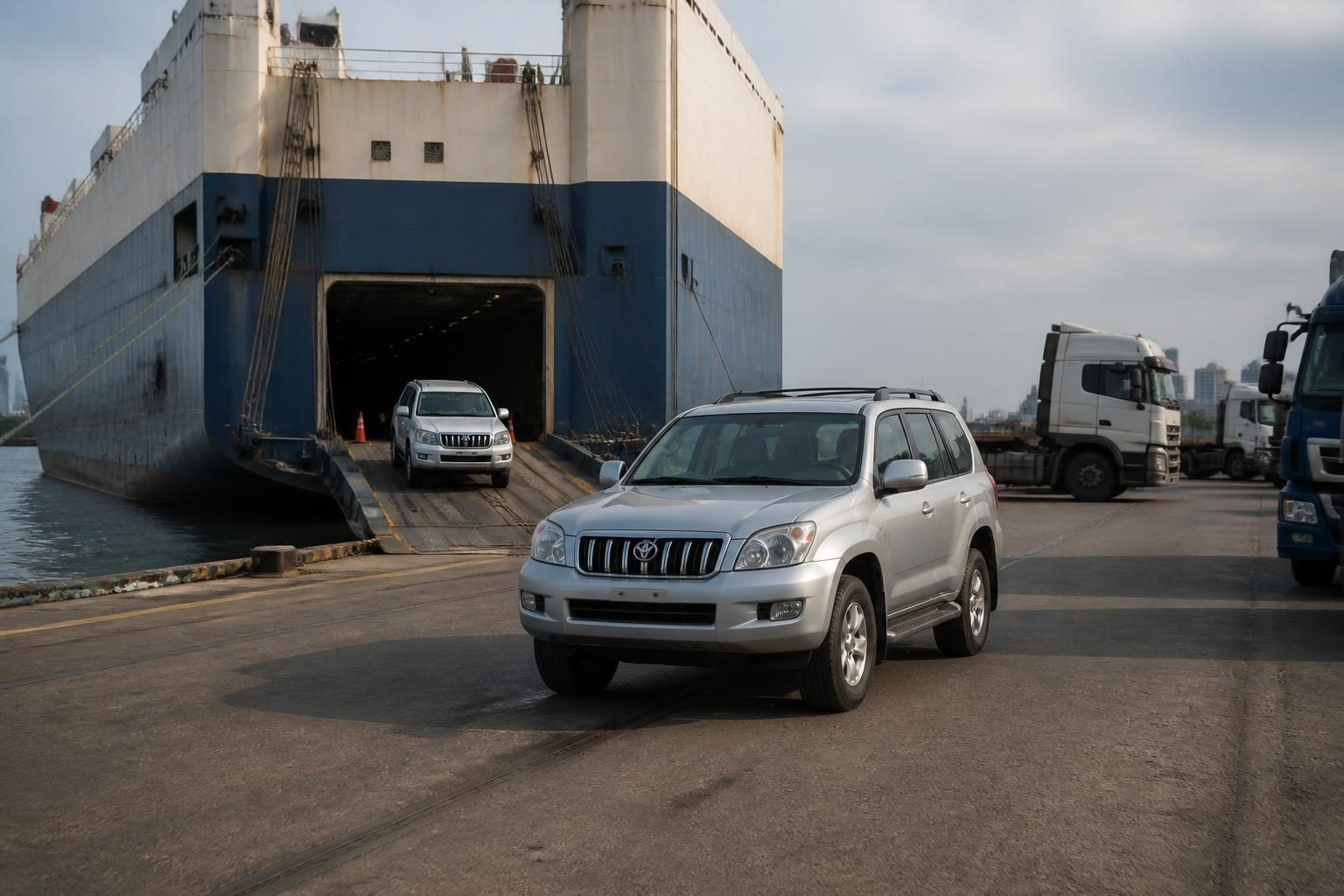
Vehicles unload from a Ro-Ro ship beside waiting freight trucks.
Citation capsule: A Japanese vehicle imported to Malawi usually travels by RoRo to Dar es Salaam, then continues by road. Carbarn’s published pages give different sea-transit estimates, so buyers should treat timing as an estimate only and confirm the vehicle-specific schedule before payment. Inland transport and local clearance follow arrival.
You can also review the five-step buying process to understand the order, payment, shipping and tracking stages.
How Can You Check the Full Cost Before Paying?
The safest estimate starts with the vehicle’s customs value, engine size, powertrain, shipping destination and current tariff classification. A planning formula helps identify missing costs, but it cannot replace the final MRA assessment for a specific vehicle. Separate landed cost from registration, insurance and post-arrival repairs.
Estimated landed cost = vehicle and shipping price + import duty + excise duty + VAT + clearance and port charges + inland transport
Registration, number plates, insurance and local mechanical work belong in the wider road-ready budget. They should be listed separately rather than presented as part of the customs calculation.
Worked example: a planning estimate
Here is a simplified illustration, not an MRA assessment. Assume the vehicle and shipping amount is around MK15 million and customs accepts a similar customs value.
| Planning item |
Published guide or assumption |
Approximate planning amount |
| Vehicle and shipping |
Assumed customs value |
Around MK15 million |
| Import duty |
25% under the published under-2000cc guide |
Roughly MK3–4 million |
| Excise duty |
15% under the published under-2000cc guide |
Roughly MK2–3 million |
| VAT |
16.5% on the applicable tax base |
Roughly MK3–4 million |
| Clearance, port, inland delivery and local costs |
Vehicle-specific estimates |
Add separately |
| Overall planning budget |
Illustration only, not an MRA assessment |
Roughly MK25–30 million |
The final amount can change if MRA uses a different customs value or classification. Duty, VAT and customs clearance are not included in the quoted vehicle price unless the proforma invoice expressly says otherwise.
Use this checklist before committing:
- Is the vehicle under or over 2000cc?
- What engine and fuel type does it use?
- What customs value is being used?
- Which HS or tariff classification applies?
- Does a 2026 measure affect the vehicle?
- Is shipping to Dar es Salaam included?
- Are duty, VAT and clearance excluded?
- What is the estimated inland delivery cost?
- Which documents will be available before clearance?
- Who is responsible for each cost line?
A cheaper vehicle is not always cheaper after customs. Engine size, valuation and inland delivery can change the result more than the purchase price suggests. If you need a firm figure, request the vehicle-specific landed-cost estimate and compare it with the current MRA assessment.
How Can Carbarn Help You Follow the Import Process?
Carbarn’s published buying information states that buyers receive the official Japanese auction sheet and an in-house Carbarn inspection report before payment. Its five-step buying guide also explains the invoice, shipping and tracking stages for an import-to-order purchase.
Every listed vehicle is owned by Carbarn rather than supplied by a third-party broker. The listed all-inclusive price covers the vehicle, shipping and inspection. Duty, VAT and customs clearance are paid separately by the buyer, as stated in Carbarn’s Malawi import rules.
The official proforma invoice can provide vehicle details, CIF information and tax guidance. The online dashboard can include the invoice, inspection sheets, bill of lading, certificates and vessel tracking updates. Confirm the documents and cost exclusions on the proforma invoice.
Sales and support run through Carbarn Japan. The business does not operate a Malawian showroom or local test-drive facility, and it does not provide a warranty or customs-clearance service. Buyers should confirm their own clearance and registration responsibilities.
Review the five-step buying process, check Malawi import rules and eligibility, then browse eligible Japanese vehicles. You can also view an example landed-cost estimate, provided the page remains live.
The main lesson is straightforward: compare the complete import budget, not only the Japanese vehicle price. Customs value, engine capacity, duty, excise, VAT, clearance, inland transport and registration all deserve a place on the same worksheet.
Sources and verification