A compact hybrid can look like a sensible answer for Malawi. It is economical around town, comfortable on paved roads and easier to manoeuvre than a large SUV. But can a 2WD Toyota C-HR handle the M1 between Lilongwe, Blantyre, Mzuzu and other towns?
That question involves more than engine power. You also need to consider traction, clearance, potholes, hills, overtaking, passenger load and luggage. Road conditions can change along the route. In February 2025, Malawi’s Ministry of Transport reported 307 kilometres of construction across four northbound M1 project lots, although the listed lot lengths added up to 301 kilometres (Malawi Ministry of Transport, “Latest Update On-going North Bound M1 Road Reconstruction”, 2025).
Quick Answer
- A 2WD Toyota C-HR hybrid is a conditional fit for mainly paved M1 travel and normal intercity driving.
- The listed 2019 example uses a 1,797cc 2ZR-FXE hybrid engine and front-wheel drive.
- For the 2019 G/ZYX11 specification, Toyota quotes 30.4km/L under JC08 and 25.8km/L under WLTC (Toyota Japan, “C-HR G Vehicle Information”).
- The main limits are mud traction, clearance over damaged shoulders and space for heavy loads.
- Confirm the exact drivetrain, auction sheet, inspection report and landed-cost estimate before payment.
What Does the 2019 Toyota C-HR Hybrid Offer?
In Toyota Japan’s 2017–2018 S specification, the C-HR hybrid has five seats, a 1,797cc 2ZR-FXE engine, 98 PS, 142Nm and a 43-litre fuel tank. The cited model measures 4,360mm long, 1,795mm wide and 1,550mm high (Toyota Japan, “C-HR S Vehicle Information”, 2017–2018). That makes it a compact road crossover, not a large off-road SUV.
The 2019 Toyota C-HR hybrid example supplied for this guide records 73,000 kilometres, auction grade 4.5, five seats, hybrid power and FWD. Its listing records the engine as 1,800cc, which is rounded data. Toyota’s exact Japanese specification gives the displacement as 1,797cc.
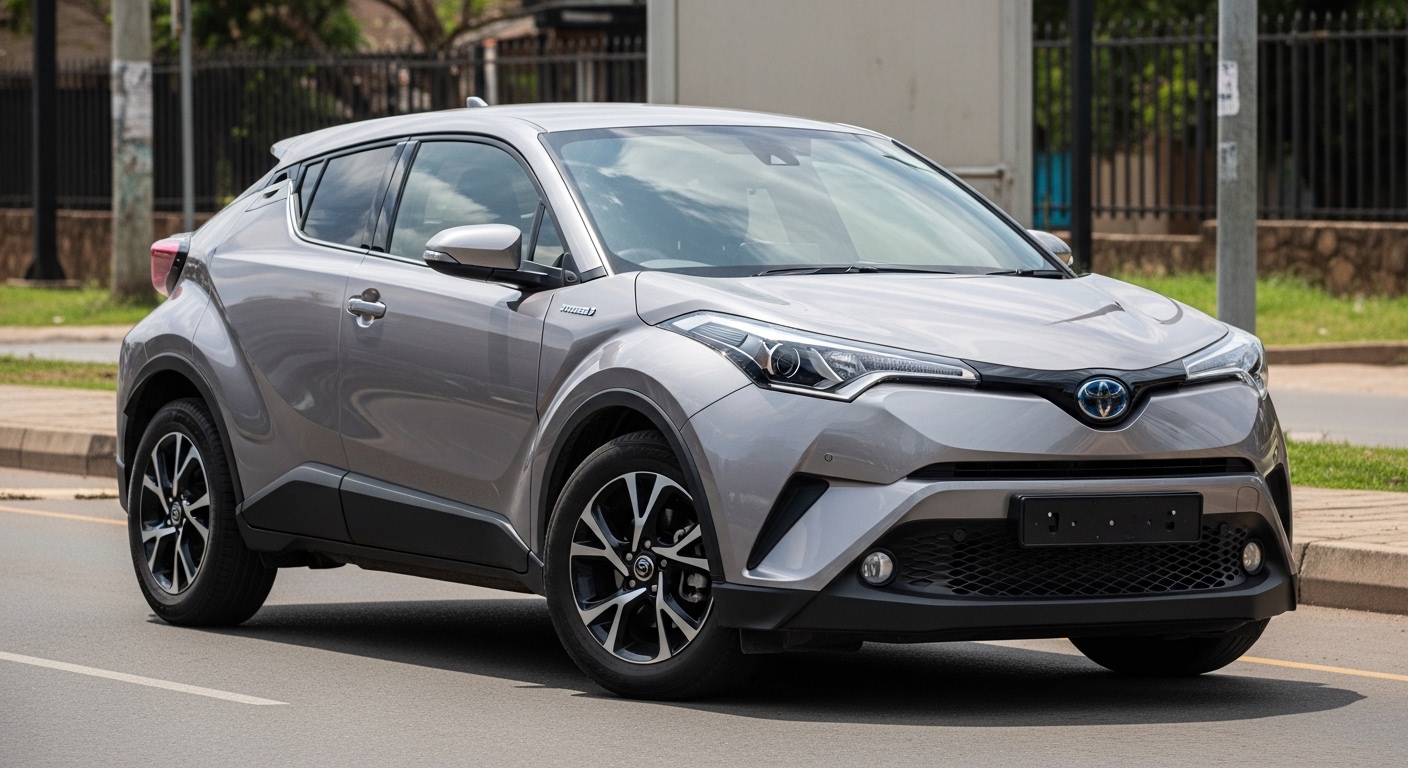 2019 Toyota C-HR
The public vehicle page confirms the year, mileage, grade, hybrid power and FWD layout. Confirm the exact grade and model code on the underlying vehicle record before relying on variant-specific specifications. C-HR specifications vary by year, grade and model code, so the badge alone is not enough. You can also check the Toyota C-HR specifications before comparing vehicles.
Citation capsule: The Japanese-market Toyota C-HR hybrid combines a 1,797cc 2ZR-FXE engine with five seats, an electrically controlled continuously variable transmission and front-wheel drive. Its compact dimensions suit town and paved intercity driving, but they do not indicate the ground clearance or traction of a dedicated 4WD vehicle (Toyota Japan, “C-HR S Vehicle Information”, 2017–2018).
Is 2WD Enough for Malawi’s M1?
For paved roads and normal dry access roads, 2WD is usually adequate. The limitation appears when the surface becomes muddy, loose, steep or badly rutted. Toyota’s original launch announcement listed the 1.8-litre hybrid as a 2WD model, while the 1.2-litre turbo version used 4WD (Toyota Global, “TOYOTA Launches New C-HR”, 2016).
This C-HR’s 2WD layout is front-wheel drive, or FF, so engine power goes to the front wheels. That can work well on tarmac, ordinary city roads, dry gravel and moderate paved hills. It also keeps the drivetrain simpler than a vehicle with driven front and rear axles.
| Driving condition |
General expectation for a 2WD C-HR hybrid |
Main consideration |
| Lilongwe or Blantyre urban driving |
Strong fit |
Compact size and hybrid stop-start efficiency |
| Paved M1 travel |
Strong fit |
Slow for potholes and roadwork transitions |
| Normal paved hills |
Suitable |
Load and vehicle condition affect performance |
| Dry, maintained gravel |
Usually suitable with care |
Tyres and speed matter |
| Muddy rural road |
Weak fit |
Limited traction |
| Deep ruts or sand |
Poor fit |
Clearance and traction become major concerns |
| Regular farm or construction tracks |
Consider another vehicle |
A higher-clearance 4WD may suit better |
2WD and ground clearance solve different problems. The drivetrain affects how power reaches the road. Clearance affects whether the underside strikes a rut, drainage channel or raised road edge. A 4WD vehicle may still damage its suspension or underbody if driven too quickly.
[UNIQUE INSIGHT] For many M1 users, the real decision is not simply 2WD versus 4WD. Tyre condition, road speed and clearance may affect your journey more often than the extra driven axle. If you mostly remain on paved routes, 2WD can be a sensible choice.
Citation capsule: A 2WD C-HR hybrid is best understood as a road-focused crossover. It can suit paved M1 travel and dry gravel roads, but buyers who regularly face mud, deep ruts, loose steep climbs or damaged shoulders should consider a vehicle with more clearance and stronger off-road ability.
Can the C-HR Handle Malawi’s Hills and Overtaking?
The C-HR hybrid may manage ordinary paved hills, but a fully loaded car may not accelerate like a larger SUV. Toyota Japan lists the cited petrol engine at 98 PS and 142Nm, while the official specification does not present those figures as total hybrid-system output (Toyota Japan, “C-HR S Vehicle Information”, 2017–2018).
Maintaining speed on a climb is different from accelerating uphill. A lightly loaded C-HR may feel comfortable on normal paved gradients. Four adults, luggage, air-conditioning and a long climb will demand more planning, especially when overtaking slower traffic.
The hybrid motor helps when pulling away and during moderate acceleration. Under sustained hard acceleration, the petrol engine may run at higher revs through the e-CVT. That sound can feel busy, but sound alone cannot diagnose whether there is a fault. Used condition matters more than the 2WD badge alone.
Before importing, check for hybrid-system warning messages, dashboard warning lights, smooth acceleration and consistent brake feel. Tyres also matter. Worn or mismatched tyres can make a modest hill feel more difficult, particularly on wet or loose surfaces.
Citation capsule: A 2WD C-HR hybrid can be adequate on Malawi’s paved hills when driven within its limits. The main question is not whether it can climb, but whether the buyer expects effortless overtaking with a full load. A clean inspection report, healthy hybrid system and good tyres matter greatly.
How Economical Is the C-HR on Long-Distance Trips?
For the 2019 G/ZYX11 specification, Toyota quotes 30.4km/L under JC08 and 25.8km/L under WLTC. These controlled results help compare similar Japanese specifications, but Toyota warns that actual economy varies with driving conditions (Toyota Japan, “C-HR G Vehicle Information”, 2019).
Hybrid savings are usually strongest in stop-start town driving. Braking can recover energy, while electric assistance helps during low-speed movement. On a steady, fast M1 run, the petrol engine does more of the work and the difference can narrow.
| Driving pattern |
Expected hybrid benefit |
| Stop-start town driving |
Strongest |
| Mixed town and highway use |
Moderate |
| Constant high-speed cruising |
Advantage narrows |
| Hilly, fully loaded driving |
Fuel use rises |
| Low tyre pressure or heavy roof load |
Fuel use rises |
Your actual result will depend on speed, traffic, passengers, luggage, air-conditioning, tyre pressure and road gradient. A driver travelling between Lilongwe and Blantyre may see a different result from someone using the C-HR mainly on open highway.
The C-HR still makes sense if your driving mixes town use with occasional long-distance travel. A larger petrol SUV may offer more clearance and load space, but it generally asks you to accept greater routine fuel demand. Avoid relying on an unverified listing figure. Use the official cycle and exact variant when comparing vehicles.
Citation capsule: Toyota quotes 30.4km/L under JC08 and 25.8km/L under WLTC for the 2019 G/ZYX11 C-HR hybrid, not as a promise of real-world consumption in Malawi. The hybrid’s advantage may be clearer in stop-start urban driving than on a fast, fully loaded journey. Keep the test-cycle label visible (Toyota Japan, “C-HR G Vehicle Information”, 2019).
Potholes, Roadworks and Clearance
On imperfect M1 sections, the bigger concern is clearance and underbody condition, not whether the hybrid can travel a long distance. In February 2025, the Ministry of Transport described works on four lots between the KIA turn-off, Mzimba and Chiweta (Malawi Ministry of Transport, “Latest Update On-going North Bound M1 Road Reconstruction”, 2025).
The report listed project sections of 102km, 86km, 46km and 67km. Those figures add up to 301km, while the Ministry described 307 kilometres under construction. That difference is worth preserving rather than presenting the two totals as identical.
Road conditions can improve in one section while construction, broken edges or drainage changes affect another. In April 2026, the Ministry reported that a 9.5km Crossroads to Kanengo section in Lilongwe had been upgraded to a four-lane dual carriageway (Malawi Ministry of Transport, “Mhango Commissions China-Funded M1 Road Expansion in Lilongwe”, 2026).
 A silver hybrid sits on the shoulder of a quiet paved highway through dry grassland and hills.
Reduce speed before potholes rather than braking sharply inside them. Avoid sudden drops at the road edge, cross drainage changes slowly and leave extra stopping distance behind larger vehicles. After a hard impact, inspect the wheels, tyres, suspension and underside.
The cited Toyota and vehicle-page sources do not provide a ground-clearance figure for this exact Japanese hybrid variant. That is deliberate. A figure from a different North American petrol model would not answer the Malawi buyer’s question accurately.
Citation capsule: On Malawi’s M1, a C-HR buyer should think about clearance and road discipline as much as drivetrain. Government updates show that road conditions and construction stages vary by section. A 2WD C-HR can be suitable, but it should be driven as a compact road crossover rather than a 4WD off-roader.
Is the C-HR Practical for Passengers and Luggage?
The listed 2019 Toyota C-HR has five seats, a 4,385mm body and a 1,440kg vehicle weight according to the 2019 G specification (Toyota Japan, “C-HR G Vehicle Information”). That combination suits two adults or a small family better than five adults carrying bulky luggage.
Its compact footprint can make town driving easier. The front seats and driving position should also suit long paved journeys. The compromise may come from the sloping roofline and compact crossover shape, which can make the rear cabin and luggage area feel less flexible than a wagon or people-mover.
Five seats do not always mean five adults plus luggage will be comfortable. Before choosing, picture one large suitcase, two medium bags, tools, a cooler and travel supplies. If those items regularly travel with you, a larger vehicle may make more sense.
Rear visibility may also feel more restricted because of the small rear windows and rising bodywork. That can matter when manoeuvring in busy areas, although a reversing camera or parking sensors can help when fitted to the exact vehicle.
Citation capsule: The C-HR’s five-seat cabin works well for a couple or small family, but its coupe-like roof and compact luggage area limit flexibility. If regular M1 trips involve five adults, large bags or business equipment, a larger wagon, people-mover or SUV may be a better fit.
Who Should Choose a 2WD C-HR, and What Should They Inspect?
Choose the 2WD C-HR if most journeys are paved and fuel economy matters more than off-road traction. For the listed 2019 G/ZYX11 example, Toyota confirms a five-seat, 1,797cc hybrid with FF drive and quotes 30.4km/L under JC08 and 25.8km/L under WLTC (Toyota Japan, “C-HR G Vehicle Information”).
| Buyer profile |
Recommendation |
| Lilongwe commuter with occasional M1 trips |
2WD hybrid makes a lot of sense |
| Blantyre driver travelling on paved routes |
Strong option |
| Small family carrying moderate luggage |
Suitable |
| Buyer focused on town fuel use |
Strong fit |
| Driver regularly using muddy village roads |
Look beyond the C-HR |
| Farm, construction or rural-road user |
Consider higher clearance |
| Driver often carrying five adults and luggage |
Consider a larger vehicle |
| Buyer comparing import costs |
Verify engine size and final invoice |
Because the buyer cannot inspect the vehicle locally before ordering, the auction sheet and inspection report deserve close attention. An auction sheet is the official Japanese auction record. The auction grade is a broad condition indicator, not a replacement for detailed comments and photographs.
| Check |
Why it matters |
| Model code and year |
Confirms the exact specification |
| Engine code and displacement |
Helps assess the import calculation |
| 2WD or 4WD |
Sets realistic traction expectations |
| Auction grade |
Indicates recorded condition |
| Odometer |
Helps assess wear |
| Hybrid warning lights |
May indicate diagnostic work |
| Tyres and wheels |
Affect grip and pothole resilience |
| Underbody and suspension |
Important for rough-road use |
| Body and interior notes |
Shows condition beyond the model badge |
| Landed-cost estimate |
Separates the vehicle price from the final bill |
The 2019 example’s page records a 4.5 auction grade, 73,000 kilometres, a clean underbody and a minor lower-side-panel imperfection (2019 Toyota C-HR vehicle page, retrieved 2026). Those details make it a useful example, but they do not describe every C-HR.
Engine capacity can affect Malawi’s duty and tax calculation. Malawi Revenue Authority measures for 2026/27 say a hybrid vehicle may fall within the applicable excise category, subject to tariff classification and other charges (Malawi Revenue Authority, “New Customs & Excise Tax Measures for the 2026/27 Financial Year”, 2026). Review the Malawi import rules and duty guidance, but treat a seller’s proforma estimate as provisional: Malawi Customs assesses the final duties, taxes and fees. Duty, VAT and customs clearance are separate costs.
[UNIQUE INSIGHT] A simple buyer score can help. If more than 80% of your driving is paved, most trips carry fewer than five people, and you avoid regular mud, a 2WD hybrid deserves serious consideration. If those answers are mostly negative, start with a different vehicle type.
Comparing a Japanese C-HR Before Importing
A reliable comparison should show the exact year, drivetrain, engine size, odometer, auction grade, inspection evidence and estimated landed cost. The published Toyota C-HR listings show 26 listings in a snapshot dated 13 August 2026, but counts and vehicle details change as listings update.
Toyota C-HR price and long-distance planning
This guide does not provide a full Toyota C-HR price comparison in Malawi. It explains how to plan the vehicle price, shipping, duty, VAT and customs clearance as separate parts of the landed cost, then how the C-HR may suit long-distance driving on mainly paved routes.
Compare the selected vehicle against other C-HR examples rather than judging one listing in isolation. Look for differences in model code, grade, tyres, underbody condition, mileage and equipment. A lower odometer does not automatically outweigh a better inspection record or a cleaner auction sheet.
The buying process should also be clear before payment. The Japanese import process explains vehicle selection, ordering, payment, inspection, shipping and dashboard tracking. The route runs from Japan to Dar es Salaam by RoRo, followed by road transport into Malawi. Transit estimates vary, so confirm the final quote rather than relying on one general number.
The vehicle price should never be treated as the complete on-road figure. Ask how shipping and inspection are covered, then separate those costs from duty, VAT and customs clearance. The vehicle page’s estimated landed-cost panel is useful for planning, but the final figures are confirmed on the proforma invoice.
Citation capsule: A Japanese C-HR comparison should begin with the exact drivetrain, engine size, auction sheet and inspection report. Listing counts, transit estimates and landed-cost panels can change. Use them for planning, then confirm the final vehicle details and payment figures on the official proforma invoice.
Is a 2WD Toyota C-HR Hybrid Enough for Malawi?
For the listed 2019 G/ZYX11 example, Toyota quotes 30.4km/L under JC08 and 25.8km/L under WLTC, with a 2WD layout (Toyota Japan, “C-HR G Vehicle Information”, 2019). Those figures support considering it as a road car for paved travel, not as an all-terrain vehicle.
A conditional yes makes sense if you mainly drive paved roads, travel between major towns, carry a moderate load and can slow down for potholes and roadwork transitions. It may suit ordinary hills and long-distance travel without 4WD, but that depends on gradient, load, tyres, clearance and vehicle condition.
Choose another type of vehicle if you regularly use muddy village roads, deep ruts, flooded sections, loose steep climbs, farm tracks or construction sites. Also look elsewhere if five adults and bulky luggage are common.
compare Toyota C-HR hybrid and 2WD listings
Sources and retrieval dates
- Toyota Japan, “C-HR S Vehicle Information, August 2017 to May 2018”, retrieved 2026-08-13, https://toyota.jp/ucar/catalog/brand-TOYOTA/car-CHR/201708/10111065/
- Toyota Global, “TOYOTA Launches New C-HR”, retrieved 2026-08-13, https://global.toyota/jp/detail/14478678/
- Malawi Ministry of Transport, “Latest Update On-going North Bound M1 Road Reconstruction”, retrieved 2026-08-13, https://transport.gov.mw/index.php/resource-centre/media/top-news/165-latest-update-on-going-north-bound-m1-road-reconstruction
- Malawi Ministry of Transport, “Mhango Commissions China-Funded M1 Road Expansion in Lilongwe”, retrieved 2026-08-13, https://transport.gov.mw/index.php/resource-centre/media/top-news/210-mhango-commissions-china-funded-m1-road-expansion-in-lilongwe
- Carbarn Malawi, “Toyota C-HR Price in Malawi | Japan Stock”, retrieved 2026-08-13, https://www.carbarn.mw/cars/toyota/c-hr
- Carbarn Malawi, “2019 Toyota C-HR in Malawi, Price and Japan Stock”, retrieved 2026-08-13, https://www.carbarn.mw/vehicles/2019-toyota-c-hr-10433
- Carbarn Malawi, “How to Buy a Japanese Car from Carbarn Malawi”, retrieved 2026-08-13, https://www.carbarn.mw/how-to-buy
- Carbarn Malawi, “Car Import Rules and Regulations in Malawi”, retrieved 2026-08-13, https://www.carbarn.mw/import-rules-and-regulations