Malawi's total vehicle population stood at 409,745 in 2025, counting the period up to 18 December 2025. The figure comes from Table 5.10 on page 67 of the Malawi Government's Annual Economic Report 2026, which reproduces Ministry of Transport and Public Works data.
A headline number like that is easy to find and hard to use. If you're about to import a car from Japan, you want to know what the count actually covers, what it leaves out, and whether it changes anything about the car you should choose. This short explainer does exactly that, in plain terms.
Quick Answer
- Malawi's total vehicle population was 409,745 in 2025, per Table 5.10 of the Annual Economic Report 2026, with figures covering the period up to 18 December 2025.
- The same table reports 27,004 vehicles newly registered in 2025.
- The total says nothing about vehicle age, condition or fuel type.
- Importers face no age limit, but the car must be right-hand drive and you must plan registration yourself.
What did the report count?
The 409,745 figure is the total vehicle population given in Table 5.10 of the Annual Economic Report 2026, published by the Ministry of Finance. The table's source line credits the Ministry of Transport and Public Works.
Two details matter when you quote it. First, the report states that its figures cover the period up to 18 December 2025, so the count is not quite a full calendar year. Second, the report doesn't spell out exactly what sits inside the total, so avoid reading more into it.
A "vehicle population" figure most likely reflects vehicles on the official records, though the report doesn't define it. It is probably not a roadside survey, and we can't say whether every vehicle counted is still running.
How does the fleet compare with new registrations?
The same table also tracks vehicles newly registered each year, and our sister post on newly registered vehicles in Malawi covers that series in full. In short, 27,004 vehicles were newly registered in 2025. This post stays with the whole fleet, so the two numbers sit side by side below.
| Measure (Table 5.10, Annual Economic Report 2026) |
Figure |
| Total vehicle population, 2025 |
409,745 |
| Newly registered vehicles, 2025 |
27,004 |
Our own arithmetic puts 27,004 at about 6.6% of 409,745, or roughly one vehicle in fifteen. Treat that as a rough sense of scale, not a growth rate. The report doesn't explain how the two rows relate, and it doesn't say whether vehicles taken off the register are removed from the total.
The report also gives no reasons for changes in either number. We won't invent any. If you read a confident explanation elsewhere, it's that writer's view and not something the table supports.
What can't the total tell you?
The fleet total answers one question, "how many", and nothing else. The Annual Economic Report 2026 gives no breakdown of the 409,745 figure by age, condition or origin, so anyone who tells you what the "typical" Malawian car looks like is guessing.
The report does not tell you:
- The age mix. How many vehicles are five years old and how many are twenty-five.
- How many are still running. A register can carry vehicles that have been parked up or scrapped.
- Fuel type. The split between petrol, diesel and hybrid is not published here.
- Where the vehicles came from. The table doesn't separate used imports from new or locally assembled vehicles.
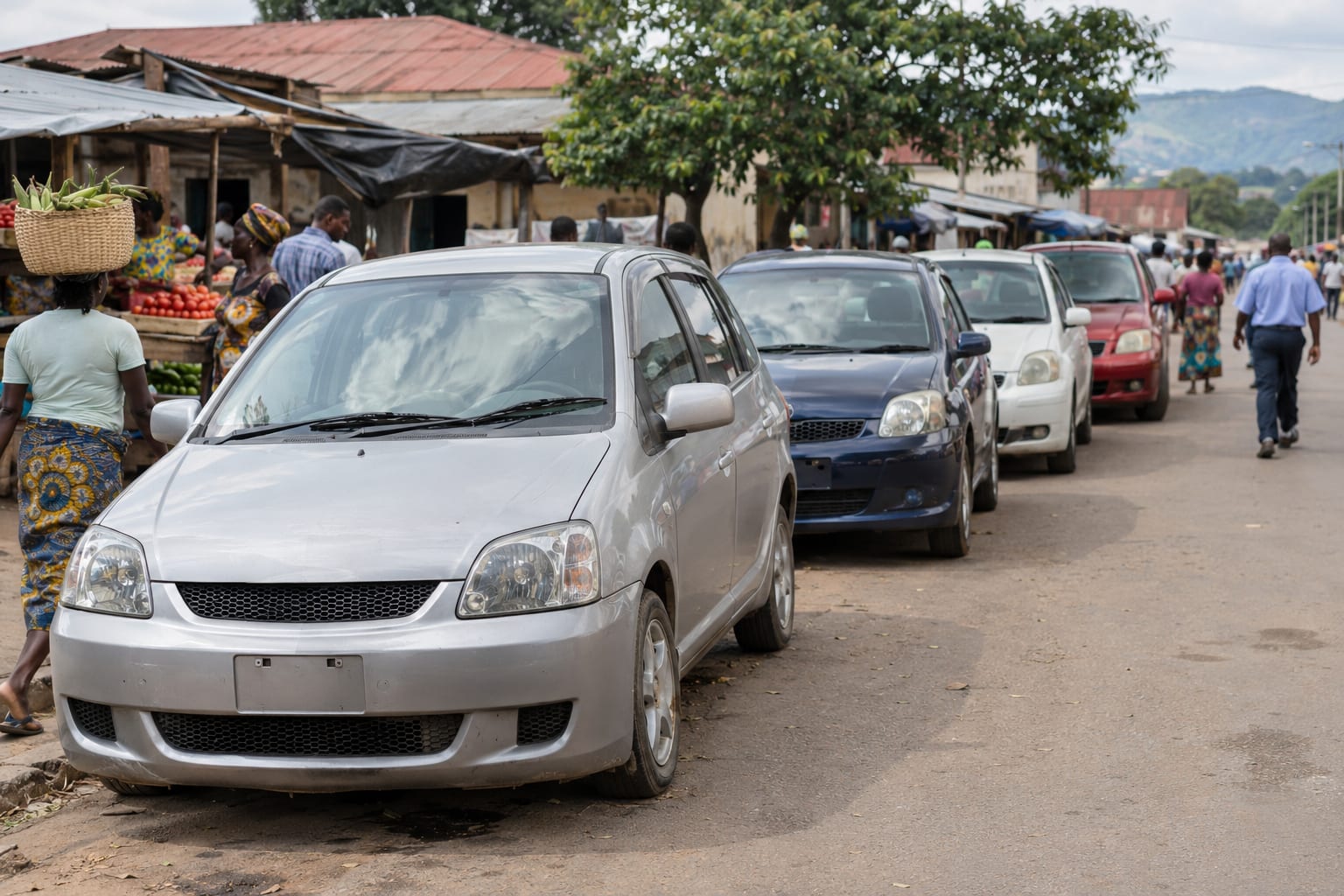 Illustration: Compact cars parked beside market stalls as pedestrians pass.
Why does this matter to you? Two fleets of the same size can need very different parts and servicing. A fleet of mostly ten-year-old Japanese hatchbacks and a fleet of mostly new pickups would both show up as one number, yet the mechanic down your road would have a very different day in each.
So don't read 409,745 as "409,745 cars you'll pass in Lilongwe or Blantyre". It's the size of the register, and that's all.
Method and sources. The 409,745 and the 27,004 are from Table 5.10 on page 67 of the Malawi Government's Annual Economic Report 2026, which credits the Ministry of Transport and Public Works and covers the period up to 18 December 2025, read on 19 November 2026. The 6.6% share is our arithmetic. The import rules are from Carbarn's Malawi import rules and regulations page, read on 21 November 2026.
What does it mean if you're buying?
Malawi's fleet is sizeable but not huge, so a car that mechanics already know and that parts suppliers already stock is worth more to you than any statistic.
Parts and servicing come first. Common Japanese models that are easy to service locally make a lot of sense here. A rarer model might look like a bargain in Japan, yet cost you time and money the first time it needs a part that nobody in Lilongwe or Blantyre carries.
No age limit widens your choice. Carbarn's import rules and regulations page confirms that Malawi sets no age limit on imported vehicles. That opens up older, cheaper stock that buyers in some countries in the region cannot legally import. Be honest with yourself about the trade-off. A very old car can carry worn suspension, tired rubber and a thinner resale market, so read the auction sheet and inspection report closely before you commit.
Right-hand drive only. The same page states that only right-hand drive vehicles are accepted, with an exception for special-purpose vehicles such as ambulances and fire engines.
Registration is your job. Every vehicle on Malawian roads must be registered with the Directorate of Road Traffic and Safety Services, or DRTSS, which sits under the Ministry of Transport and Public Works. The exporter doesn't do this for you. Our sister post on new registrations walks through what that step involves.
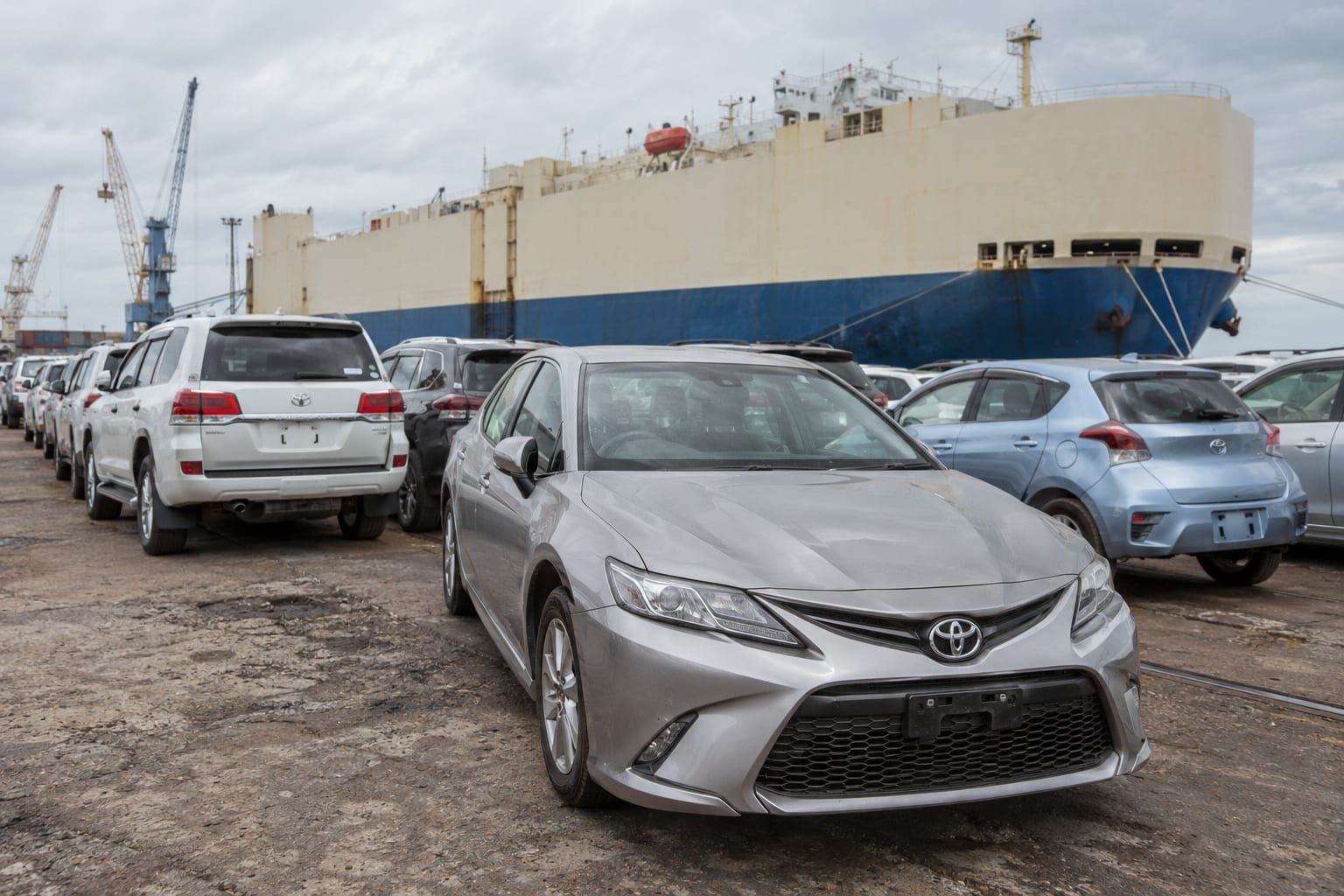 Illustration: Rows of cars parked beside a docked vehicle carrier ship.
Budget for the landed cost, not the listed price. The landed cost is the total after duty, VAT and customs clearance are added to the vehicle price. The listed price covers the vehicle and shipping from Japan. Duty, VAT and clearance are not included and are paid separately.
Customs duty, excise and VAT are all worked out on the car's CIF value, which is the cost of the vehicle plus insurance and freight. Excise rises with engine capacity, which is why engine size quietly decides a large part of your bill. Check Carbarn's import rules and regulations page for the current rates, and expect the final figures on your proforma invoice, the formal quote you pay against. Our guide to the true landed cost of importing a used car to Malawi works through what lands on top of the price.
How does Carbarn Malawi fit in?
Carbarn is a Japan-based exporter that sells used Japanese cars to Malawian buyers to order. Carbarn owns every car it lists, so there are no brokers and no third-party cancellations. Before you pay, you see two reports on each car: the official Japanese auction sheet and an in-house Carbarn inspector report.
Cars ship RoRo, meaning roll-on roll-off, to Dar es Salaam, plus inland road transport into Malawi. Transit times vary, so treat any timing as a guide and confirm it before you order. Full payment is required before shipment, and every sale is handled from Japan.
For the wider picture, the complete guide to buying and importing Japanese used cars in Malawi covers the whole process.